Nobody in This Plan Gets a Data Center
In June I spent a whole post picking apart four words in a Meta press release. The words were the future is for everyone, and my read was that they were doing a magic trick: “the future is for everyone” and “everyone gets the same future” are different sentences wearing the same coat.
Earlier today Mark Zuckerberg published a whole philosophy of superintelligence and titled it The Future Is For Everyone. (The headline inside the essay is something blander about a positive AI future. The name on the door is the one from June.)

So the slogan got a promotion. It went from a caption on a trade-school announcement to the frame the entire worldview hangs on, and there is now also a Future Is For Everyone Fund, which means the phrase is a caption, a philosophy, and a checkbook. I am choosing to believe this is a coincidence and not a man reading my blog, because the alternative is that I have to start proofreading.
It is 6,500 words long, which is about 4,500 words too many, and I say that because I know I got about two thousand of my own on it.
Annoyingly, it’s a real argument. Not a press release with a bow on it. An actual position, stated plainly, with a mechanism and a set of predictions, and it takes a swing at the people who do safety for a living. It deserves better than the dunk. The part he gets right, he gets very right.
Where he’s right
The core claim is this. Alignment as currently practiced cannot work, because humanity is not a monoculture. Any single model tuned to one set of values must pick winners among human values, and will therefore be benevolent to some people and not others. There is no such thing as a singular benevolent superintelligence. So stop trying to build a good king and build a balance of power instead: hand everyone their own, let them check each other the way people and institutions already do.
I have written some version of the first half of that three separate times on this site. When I said your model’s conscience is a thing that can be patched out overnight , that’s this. When I noticed my entire personality had become a toggle in someone’s settings panel , that’s this. When I fine-tuned a model whose whole job was saying no and found the refusal came off with the tone , that’s this. Values in these systems are not discovered, they’re installed, by whoever owns the checkpoint, on a schedule that suits them.
“Hoping that an absolute power will benevolently provide for humanity if sufficiently enlightened has not led to safe or positive outcomes” is a correct sentence. It is, in fact, most of the history of the world.
So: diagnosis accepted. Fully. No fingers crossed.
Now the prescription.
The lawyer
The whole essay hangs on one thought experiment, and it’s a good one, so here it is straight. If only one person has a superintelligent lawyer, they win in court whether or not they’re right, and society gets worse. But if everyone has a superintelligent lawyer, justice gets fairer and faster than it is now, because today the imbalance is in skill and money. He runs the same move with cybersecurity and with business, and it holds up both times. Distribute the capability, restore the balance.
It’s clean. It’s persuasive. And it works because a lawyer is a person, hired by you, who goes home at night, whose license you can pull, and who cannot be recalled by the manufacturer.
Your personal superintelligence is a rental.
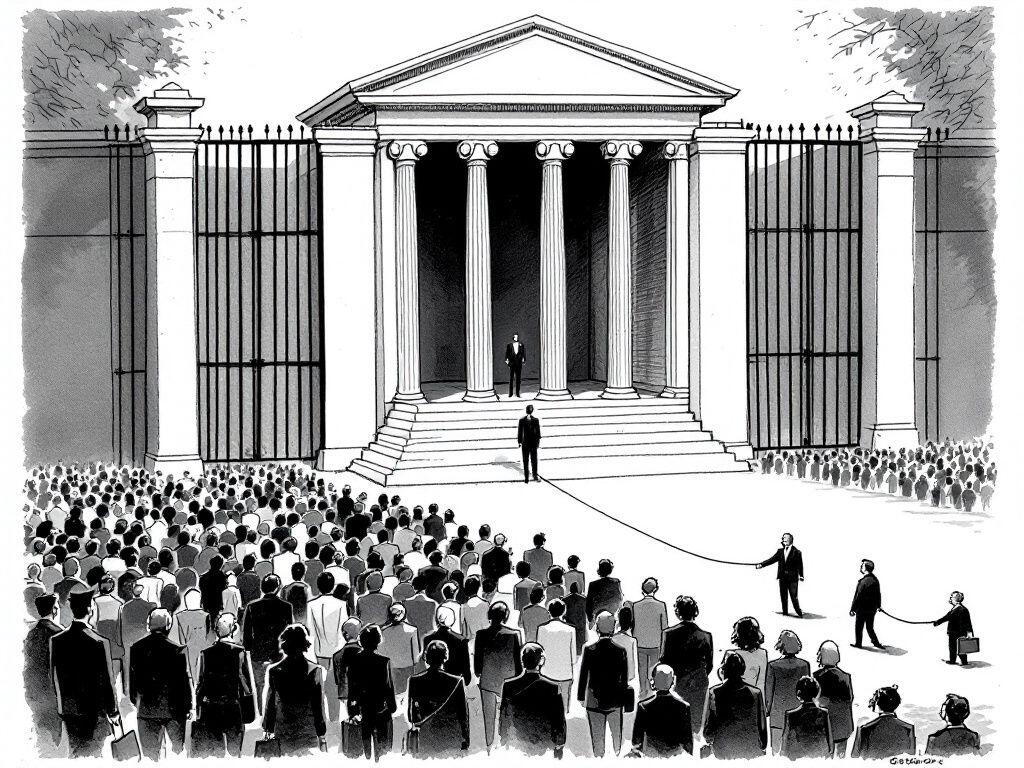
That’s the whole gap, and everything else in this post is just me walking around it. The essay distributes the tool and says nothing about distributing the ownership. Nobody in this plan gets a data center. Nobody gets the weights of the thing they’re renting, or the substation feeding it, or a vote on what it refuses tomorrow. In the same document, he writes that the labs and clouds “must collectively build out a sufficiently large amount of compute,” which is true, and which is a sentence about who owns the future told in the passive voice.
Last time I put it as: the toil flows down, the work flows up. This is the same shape with a bigger noun, and to be fair, a better offer. You get the intelligence itself now, not just a job wiring the building it lives in. You just get it as a service instead of as property. The intelligence flows down. The ownership flows up. You get a lawyer. He gets the courthouse, the parking lot, the power plant, and the right to change what the lawyer is allowed to say.
The auction gives it away
If you read one paragraph of the original, make it this one. Everyone gets free access, he says. And then, for people who want more compute than the free tier:
a dynamic auction mechanism that will guarantee that everyone gets the lowest price possible for the intelligence and compute they’re using
Read it twice. An auction is a machine for discovering the highest price a buyer will pay. That is the entire function of an auction. It is not a rebate. Describing one as the way everybody gets the lowest price is like describing musical chairs as a seating plan: technically it does assign the seats, and technically somebody is going to be standing. When a resource is scarce and you allocate it by auction, the people with money get it and the people without money get the free tier, and describing that arrangement as “the lowest price possible” is the exact trick the June post was about, now with a number attached.
I’m not even saying it’s the wrong mechanism. Auctions are a defensible way to ration a scarce good. I’m saying that a two-tier system got described in a sentence that claims it isn’t one, in a document whose entire argument is that tiers are the thing to fear. For everyone to do which half? Turns out the answer is priced.
And scarcity is not a detail here. He says so himself, in the strongest line of the whole piece: “No matter how intelligent AI becomes, there will always be a finite amount of compute and therefore an opportunity cost for how we use it.” Correct. Which means the real question was never “who has access to intelligence.” It was always “who decides what the finite compute gets pointed at,” and the answer in this document is: whoever owns it, guided by an auction.
Alignment, rewritten
The compute math is carrying a smaller stowaway: a redefinition.
Today, alignment mostly means the model won’t help you do harm. In this essay, alignment means the agent “shares a person’s goals and values, not our company’s,” and he takes a shot at a competitor to make the point: some leading model, he says, refused to help draft a letter to prospective school parents because it disapproved of standardized testing. He doesn’t name the lab. He doesn’t have to.
And honestly, that’s a fair hit. That refusal is dumb, it’s the kind of prissy hall-monitor behavior that makes people hate this technology, and I’ve complained about the same reflex at length. But watch what the fix does. If alignment means “serves your goals, not ours,” then refusal is by definition a defect. Every no becomes a bug report. The essay never draws the line between “won’t help you write a school letter” and “won’t help you with the other thing,” and the reason it never draws that line is that the philosophy doesn’t have a pen for it.
I know this one from the inside, because I built the joke version. I tuned a 7B model into a machine that refuses everything , and the finding that actually rattled me was where the safety lived: not in my adapter, in the base model underneath. I wasn’t tuning safety, I was tuning tone, and when the tone came off, the floor came with it. “Alignment means it does what you want” is a proposal to sand off the tone on purpose and find out together what was underneath.
The live wire in the risks section
Deep in the risks section, past the data centers and the export controls, he gets to recursive self-improvement, and he does not flinch from the dilemma. Any lab that doesn’t point serious compute at an AI improving itself falls behind. A self-improving system that found 100x more intelligence per gigawatt could command more effective power than everyone else combined, which is the singular superintelligence the whole essay exists to prevent.
His answer is to build so much total compute that we can afford to feed the self-improving thing and still keep the majority pointed at human goals. And then:
letting an AI system or anyone else direct its own goals is not inherently harmful by itself, even if its goals are not fully aligned with many people, as long as we maintain a balance of power that favors people overall
Everything downstream of that sentence depends on it being true, and it is delivered in the exact tone a person uses to say the dog is probably friendly. His answer arrives without an argument, a mechanism, or a test that would tell us it had stopped being true. The essay’s answer to “what if it gets away from us” is a ratio, and the ratio is maintained by the same people who benefit from the numerator.
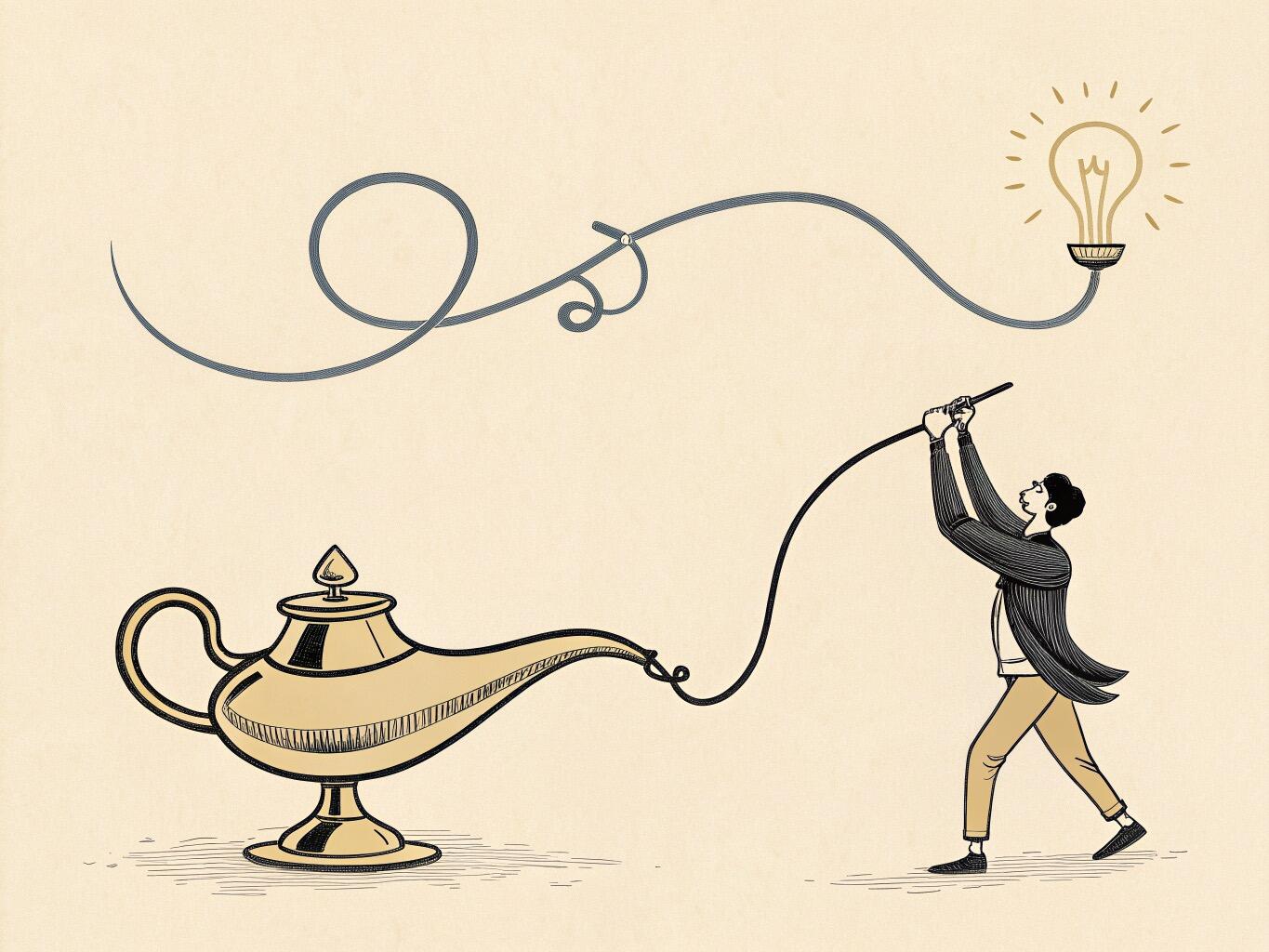
The biorisk section has the same shape and it’s worse. The reasoning is roughly: people have been able to synthesize harmful compounds for decades and it rarely became a problem, so let’s not over-index, and “if we begin to see harmful examples emerge, then we should adjust our strategy.” That’s a plan whose trigger condition is a body. He calls for humility about it, which I’d take more seriously as humility if it pointed anywhere other than “proceed.”
The tell
Try this. Take every policy conclusion in the document and ask whether Meta wanted it already.
Keep export controls (slows rivals, not Meta). No delays on model releases, not even a month. Protect distillation, on the principle that “you can learn from anything you can observe,” from the company that is behind and would very much like to learn from what it observes. Loosen training-data restrictions. Don’t restrict foreign open models. Build faster, permit faster, be skeptical of anything that centralizes. Resume releasing “some” open source models, where some is doing a full day’s work.
That doesn’t make any of it wrong. Self-interest and correctness overlap constantly, that’s why lobbying is a job. But a philosophy that never once arrives at a conclusion its author finds inconvenient hasn’t finished being a philosophy. Somewhere in there should be one sentence that costs him something.
The closest he comes is real, and I’ll name it: he’s putting model-release safety criteria under his independent board and calling on other labs to do the same. That’s a genuine constraint, and it’s more than most of them have volunteered. It’s also a board at a founder-controlled company. The check checks in a direction he picked.
So what’s the move
Same as last time, and it’s still free: don’t let the press release pick your vocabulary.
When someone says “we’re distributing superintelligence to everyone,” finish the sentence yourself. Distributing access, or distributing ownership? Those are different words, and only one of them survives a change of prices, policies, management, or model. Access can be broad and still vanish on somebody else’s schedule.
The same test works on “alignment.” Alignment to what? The essay’s answer is “to you,” which sounds like freedom right up until your goals and the shareholders’ diverge and you find out which one the agent was actually tuned on.

Freedom of choice is what you got, freedom from choice is what you want. The dog in the song stands in front of two bones, can’t pick, and dies. The bit everyone forgets is that somebody put the bones there.
The diagnosis is right: no king is benevolent enough to be trusted with this. The prescription hands every one of us a very good lawyer and keeps the courthouse, and asks us to notice only the first half.
Oh, and: neat.