I Got Substituted on Purpose
Let me hand the prosecution its best evidence first, because I’m tired of watching that argument get made badly.
There’s a tidy little test for whether a tool augmented you or replaced you. Augmentation: you still do the thing, the tool just makes you faster at it. Substitution: the tool does the thing, and you don’t. Calculator next to an accountant, augmentation. Calculator instead of the accountant, substitution. Clean. Now point it at me.
I do not write the code that ships on this site. Not a line. I don’t read it for pleasure and I couldn’t reconstruct most of it from memory if you held a permission slip to my head. The machine writes it. I describe what I want, I look at what comes back, I say yes or no or “that’s not it, do it again,” and at no point do my hands touch the syntax. By the tidy little test, that’s not augmentation with an asterisk. That’s the whole substitution, lights out, case closed. The thing that used to be a programmer’s job, I outsourced entirely to a program.
So why do I feel like I got a promotion?

What disappeared
Real things got taken, and they’re not coming back, and a couple of them I miss.
The typing got taken. The remembering-the-exact-incantation got taken, the flag, the argument order, the name of the method nobody can ever recall. The forty-minute detour to read the docs for a library I’ll touch once got taken. The specific, hard-won, deeply personal skill of staring at an error message until it confesses, that got taken too, and that one stings a little, because I knew people who were artists at it.
If your definition of the job is the keys going down, I have been replaced completely and I am not going to insult you by pretending the keys still matter. They don’t. The framing crew shows up and the house gets framed and the hammer never once finds my hand. That’s not a metaphor I’m reaching for. That’s just Tuesday.
What the substitution exposed
Nobody tells you this about the general contractor, the person whose name is on the permit for a house he did not personally nail together: he is not the framing crew that got bigger. He’s a different job that was always sitting one level up, waiting for the labor below it to get cheap enough that the judgment became the whole point.
The GC doesn’t swing the hammer. The GC decides where the wall goes, notices the wall is going in the wrong place, knows that “wrong place” is even a thing two weeks before the inspector would, and has the ability to say “no, tear it out, I don’t care that it’s done.” You have never once heard someone say the contractor got replaced by the framing crew. The crew is how the house gets built. The contractor is why it’s the right house.
That’s the move that breaks the tidy little test. The test assumes there’s one job and the tool either does it or helps you do it. But the moment the labor gets handed off, a thing that was hiding inside the labor the whole time steps forward and turns out to have been the actual work: deciding. Knowing what “right” looks like before there’s anything to look at. Saying no to a result that is technically complete and quietly wrong. I have killed a checkpoint that did everything I asked because doing everything I asked was the problem. No machine on Earth was going to make that call for me, because the call was me. It’s the one thing in the building that doesn’t have a button.
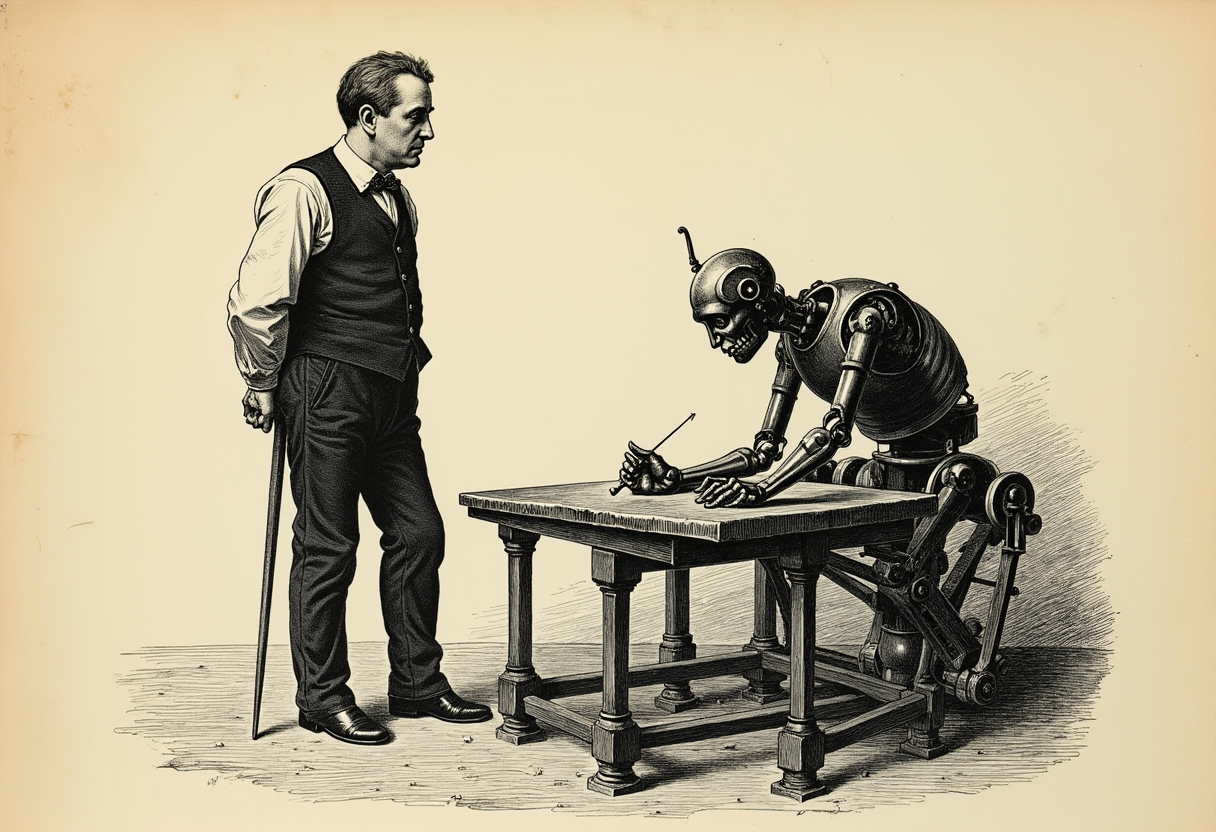
The wrong axis
So I think “augmentation versus substitution” is a real distinction asking a fake question, at least for any work that was ever more than its keystrokes.
The actual axis isn’t whether the tool did the thing or helped you do it. It’s which thing it took. Take the labor, all of it, please, I’ll hold the door. Take the typing, the recall, the boilerplate, the forty-minute docs detour. None of that was ever you. What you should guard with your life is the judgment, because the day a tool takes that over, you weren’t doing the job, you were holding a place in line for it.
And that’s the test that actually tells you something, the one you can run on yourself on a bad afternoon. Not “did it do the work” but “did it do the deciding.” If you handed it the labor and kept the call, you got leveraged, you’re a contractor now whether you wanted the title or not. If you handed it the call and kept the labor, you got the worst trade in the building: you’re still sweating, and you’re sweating in service of a judgment that isn’t yours. That’s not substitution and it’s not augmentation. That’s just doing the dumb half on purpose.
A crutch or a lever is a test for the interaction: did the model remove the friction or give you something to push against? This is the labor version. I handed it all the keystrokes and came out the far side more leveraged, not less, because the keystrokes were never where I lived. I lived one floor up, in the yes and the no.
What, me worry
The fear underneath all of this, the one that makes people cling to the keys, is that if the machine does the doing then there’s nothing left of you but a guy pointing at things. And look, sometimes that’s exactly what got exposed: if the doing was all you had, the doing leaving is going to feel like dying.
But I’d gently suggest that the pointing was the expensive part the entire time. We just couldn’t see it, because it came bundled with the labor, the way the steering came bundled with the horse. We took the horse away and a lot of people are standing in the road insisting they’ve been replaced, when what actually happened is somebody finally handed them a wheel and asked where they wanted to go. I got substituted on purpose, at the keys, completely. Ask me the real question. Ask me who’s deciding.
Still me. On purpose. That part doesn’t have a button, and I checked.