The Replicator Was Never the Point
Sooner or later every AI conversation reaches “but what about the jobs,” and everyone nods gravely. I want to split the job in two. The thing worth removing was never the work. It was the toil. Those are not the same thing.
Toil is not work
We use the two words like synonyms, and that confusion is the whole ballgame.
Toil is the part that takes something out of you and gives nothing back. It’s the timesheet, the third meeting about the meeting, the thing you’d stop doing the instant the money stopped. Work is the part that means something - the part you’d defend, the part that’s actually you pressed into the world. A novelist toils over expense reports and works on the novel. Most jobs are a bad smoothie of the two, blended so thoroughly we forgot they were ever separate ingredients.
So when people say “AI is coming for my job,” listen to which half they’re mourning. “AI does my toil” and “AI does my work” point in opposite emotional directions. One is a vacation. The other is an identity crisis. The mistake is assuming they’re the same sentence - that subtracting the drudgery somehow also subtracts the meaning. It doesn’t. They were never welded together; we just kept them in the same drawer.
I didn’t come up with this, by the way, and the people who got there first weren’t philosophers. Sometime in the mid-’70s a pack of art-school cranks from Akron, Ohio - rubber country, about as toil-soaked as America gets - recorded a song called “Toil Is Stupid .” The band was DEVO, and the whole project was de-evolution: the theory that modern man isn’t ascending toward anything, just regressing into a herd of conformist drones, which is why they dressed like industrial spuds and asked “Are we not men?” The song was so far ahead of the joke it never even got a real release - it’s still passed around as a bootleg. Three words, nailed to the door fifty years ago, and the culture filed it under novelty act. That’s the work ethic for you: it’ll happily let you mock it, right up until you mean it.
What Star Trek actually promised
Nobody on the Enterprise has a job. They have pursuits. Picard puts it flatly - “We work to better ourselves and the rest of humanity.” Nobody’s clocking in. The replicator made scarcity optional, and instead of everyone collapsing into a beige puddle of leisure, they went and got more ambitious. They explore. They study. They play terrible clarinet.
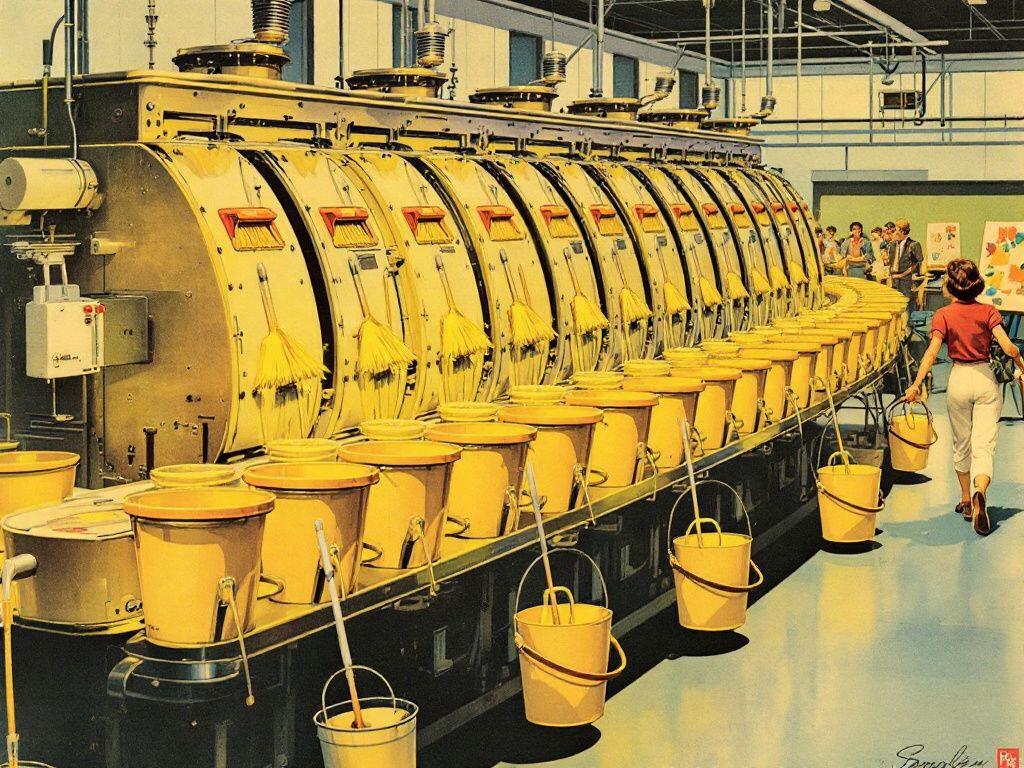
My favorite proof is the easiest to miss. In a galaxy with machines that can conjure any meal atom-by-atom for free, Joseph Sisko runs a Creole restaurant in New Orleans. By hand. On purpose. The replicator didn’t kill cooking - it killed the obligation to cook, which turns out to be the only part worth killing. Strip away the necessity and what’s left is the love. The labor went optional and the work kept its soul.
I’d like that version. I would also like to see the episode Star Trek skipped.
The part the optimists skip
This is where the work-and-toil distinction stops being a personal workflow and becomes an economic problem. The utopian version gets eaten alive here, and deserves to.
Star Trek cheats. There is no episode called “The Year the Restaurants Closed.” We meet the Federation centuries after it figured out how to feed everyone without a paycheck, and the show very politely skips the messy middle - the stretch where the work is optional but the rent absolutely is not. That gap is where real people live. You still have to eat in the years between “a machine can do this” and “society reorganized itself around that fact,” and right now nobody’s holding the bridge-toll.
I’m not above it either. I use Claude all day at work, and I love it. It quietly ate the part of my job that was always pure toil - the AWS error that says only “Access Denied” and would sooner die than tell you which permission, the Terraform files no kid ever dreamed of growing up to write, the afternoons spent spelunking CI/CD logs for the one red line that actually matters. Take that away tomorrow and hand me back the drudgery, and I won’t quit in some noble protest. I’ll clock in and do the bare minimum for exactly as long as it takes them to fire me, because a paycheck is a paycheck and hand-writing Terraform is a sentence, not a job. Optimism, not naïveté. It doesn’t matter if you believe in the destination if you lack the gas money to get there.
Why toil still looks virtuous
The economics are not the only obstacle. The other one is a ghost.
Four hundred years ago a particular strain of theology decided that toil itself was holy: that idle hands did the devil’s work and a full schedule was a moral résumé. Max Weber wrote the book on how that belief quietly became the operating system of capitalism. The jobs it was written for are mostly gone. The wiring is not. It’s spiritual malware we never patched, still running on hardware it was never meant to outlive.
You can hear it every time someone lowers their voice to admit they’d love to never work again, like they’re confessing to something. I’d be fine not working comes out the way you’d say I think I might be a little bit of a fraud. That flinch is the ghost talking. Removing the drudgery means giving up one of our favorite ways to prove we deserve dinner.
Making things anyway
Exhibit A in the exorcism is the site you’re reading.
I haven’t typed a line of its code in weeks. I directed it, judged it, threw things out, changed my mind - but the keystrokes weren’t mine. By the old gospel that should make it feel like a fraud, a thing I didn’t really make because I didn’t suffer enough for it. It doesn’t. It feels like mine completely, because the part that was mine - the argument, the point of view - was never the typing. The typing was the toil. This was the work.
That is the whole bet: not that AI leaves us nothing to do, but that it finally separates the chores from the calling and lets us keep the half that mattered. The replicator was never the point. The point was Joseph Sisko, in a kitchen he does not need, making something nobody ordered because he wants to.
I’d keep building even if nothing required it. I think that’s the most human thing I know about myself, and for the first time the future seems to agree.