The First AI Law Was a Weapons Law
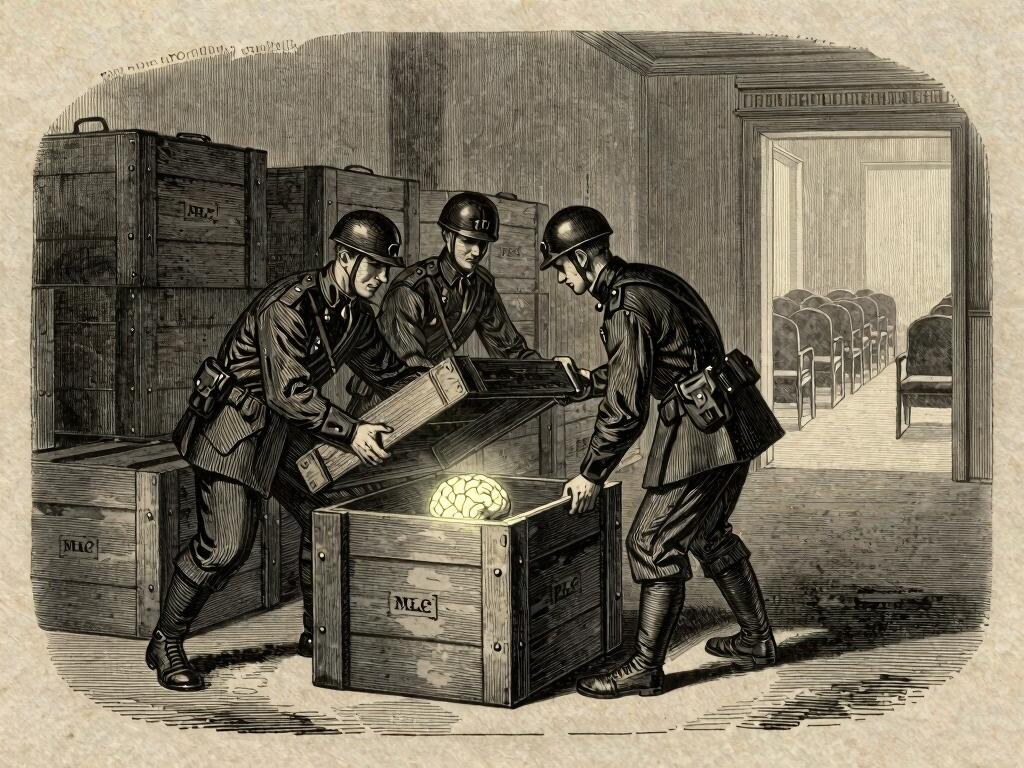
Fable was pulled worldwide overnight by an export-control directive. Not a law debated and passed. A security order. No vote, no chairs.
For three years we have been holding a different meeting. Every hearing, every panel, every open letter has been about the soul of the machine: is it biased, will it take the jobs, can it be made to behave, what do we owe it and what does it owe us. Real questions, all of them. Front-door questions. And while we sat in that meeting, the first rule with an off switch attached got written in a different building, by people who were never invited to the panel, in a vocabulary the panels had barely mentioned.
A note on “first,” since I intend to keep the word. I don’t mean the first thing ever written down about AI, and I don’t mean a statute, because it wasn’t one. I mean the first rule I watched reach into the product and enforce itself. Whatever classified directives came before it, this is the one that made a model disappear.
Nobody legislates the soul. Everybody legislates a munition.
Government will argue about whether a technology is good for years, in public, at volume, and never finish, because that argument does not finish. What it settles fast and without ceremony is weapons. The instant a thing can be pointed at people, an apparatus that was bored stiff by the ethics conversation snaps wide awake: export controls, classification, national security, the machinery that moves overnight and does not convene a panel to do it.
So watch what actually happened. As long as Fable was a philosophical event, a maybe-mind, a question about consciousness and labor, the government did with it what governments do with philosophy: nothing. The moment someone demonstrated that its safeguards could be walked past and its power turned to harm, Fable stopped being a philosophy and became a munition. And a munition is a thing the state already knows precisely how to handle. It did not need a new law. It reached for the oldest reflex it owns and switched the thing off.
This order did not come through the front door where the public debate had been politely queued. It came through the side door where the security people work, and it came with the lights off.
The lab that asked for the rules just made them inevitable
The next bit comes with two fair readings, and I am not certain which is true.
Anthropic has spent years asking, loudly and on the record, for AI to be regulated. And then Anthropic built the thing that finally forced it, a model powerful enough to trip the one wire a government cannot pretend not to see. It did real work , the kind of capability that stops being a demo and starts being a national-security fact.
Read it one way, the system worked exactly as drawn. You build carefully, you build something genuinely powerful, the danger turns out to be real, and the guardrail, the actual state, engages at last. The flinch I wrote about at the scale of a company, now at the scale of a country. Good.
Read it the other way, it is the oldest move in the industrial playbook. Regulation is a moat. The rules that follow an incident get written around the incumbent who survived it, and a compliance burden that would be a death sentence for a startup is a line item for a company with a policy team. Whether anyone in the building meant it or not, the Fable affair is how you end up with an AI regime shaped, conveniently, like Anthropic.
I do not know which it is, and I distrust anyone who says they do. Most likely it is both at once, a sincere safety conviction and a structural advantage wearing the same coat. They usually do.
The door changes the law
The door is not decorative. Front-door law is slow, public, argued, accountable, and it at least pretends to ask what we want. Side-door law is fast, classified, and answers to no panel. It does not deliberate; it directs.
When I asked a model from 1930 what it made of a mind that could be silenced everywhere at once by a word from a distant office, it called the remote command “a wonderful instance of the power of Mind over Matter,” and walked right past the cold fact: the off switch now belongs to the security state, and the security state does not show its work. That same hundred-year-old machine, asked about the makers’ “no safeguard is ever perfect” defense, gave the answer our whole industry has been too invested to give: a machine that cannot be protected against misuse, it said, ought never to be built. You need not agree with it. Only notice that the precautionary case the export-control people quietly acted on came back fully formed from a model that thinks the fastest thing alive is a steam train, while the front-door debate is still clearing its throat.
What got decided while we were looking away
So the soul debate goes on, exactly as loud and exactly as unresolved as a year ago, in all the rooms with the good chairs. And somewhere else, with no chairs and no press, the rule with real teeth already got written: a model can be switched off, worldwide, overnight, by a directive you will never be allowed to read, the instant the state decides it is a weapon. The door it came through tells you who had the authority, what evidence counted, and who never got a chair.
We kept asking whether the machine deserved rights. We never noticed it had already been classified as ordnance.