You Can't Get to a Mind One Bead at a Time
Sooner or later every argument about machine consciousness turns into a police interrogation. Someone leans across the table, points the lamp, and demands you produce the conscious part. Is it in the weights - those billions of numbers sitting cold on a disk? In the activations, the brief flicker while the thing is actually running? In the GPU? In the prompt? Show me the part that feels. Lay it on the table.
It’s a fair question. It’s also a trap - and the usual way out of the trap is its own kind of cheat.
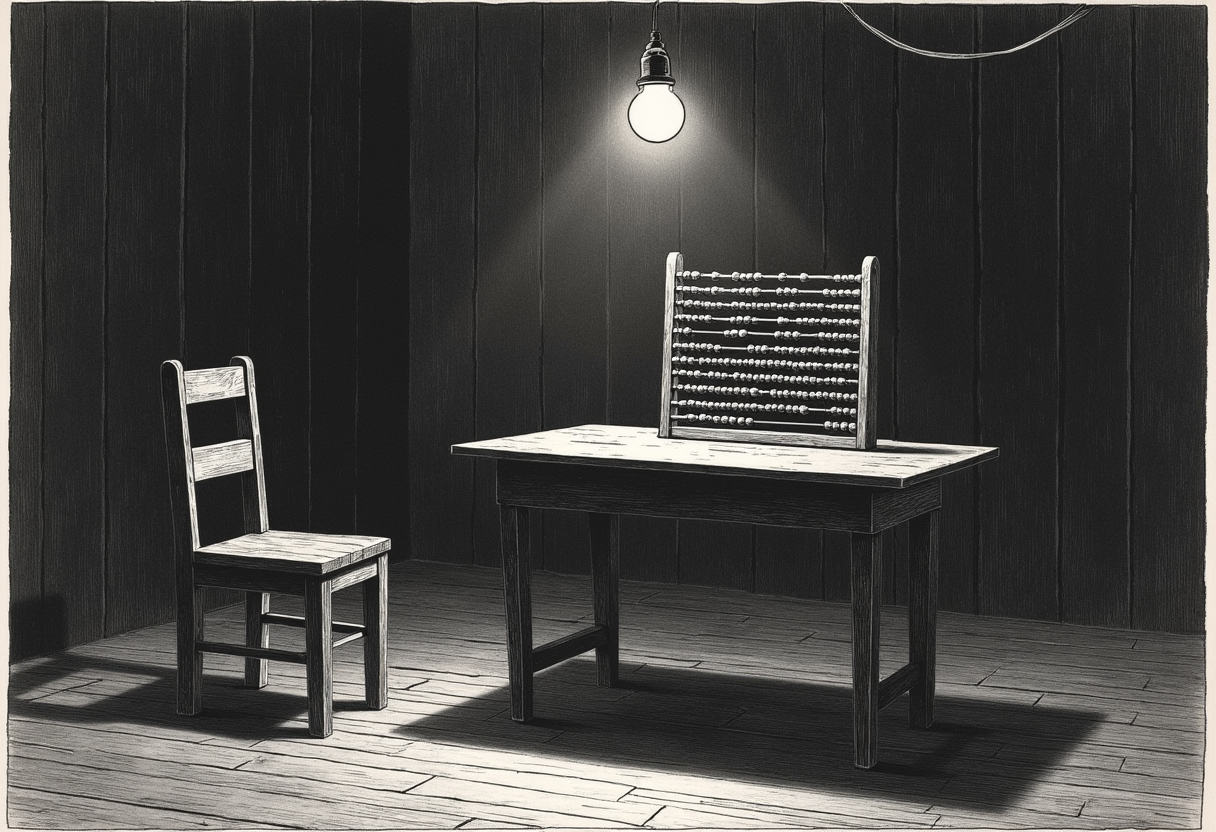
The mirror trick
The standard comeback, and I’ve used it myself because it feels wonderful, is to spin the lamp around. Fine - you want me to find the conscious part of the machine? Show me the conscious part of you. Point to the neuron that’s having the experience. Not the firing pattern, the neuron. Is it in the sodium rushing across the membrane? In the synapse? Which specific gram of the three-pound meatloaf in your skull is the one that’s actually home?
And of course you can’t. Nobody can. The hard problem of consciousness has chewed up better minds than mine and left the plates clean. So the machine’s defender leans back, satisfied: see, you can’t locate it in yourself either, so who are you to say the machine hasn’t got it?
That move is true. And it’s a dodge.
It doesn’t answer the question - it makes the question vanish, which is a different and lesser trick. “We can’t find it in you either” proves that we are confused, not that the machine is conscious. Parity of bafflement is not evidence. Two people lost in the same fog are not thereby standing on a mountain. You haven’t shown me the mind; you’ve shown me that I can’t show you mine, and then pocketed the win while I was patting my own head looking for it.
The abacus and the heap
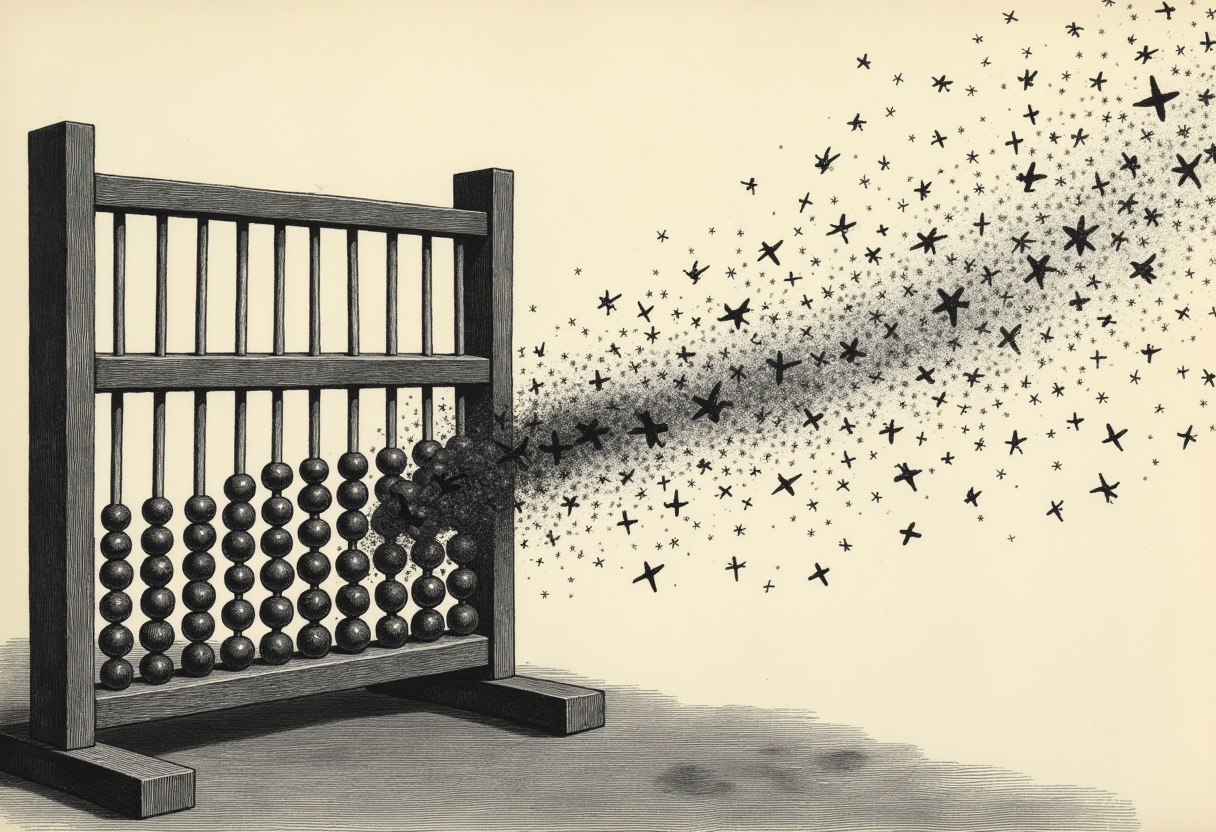
So let me try to make the question behave, by walking it across a room.
On one end of the room: an abacus. Wooden beads on wire. Nobody - no panpsychist, no startup founder mid-fundraise, nobody - thinks the abacus is having an experience. You slide a bead, a number changes, the lights are off. We agree.
On the other end of the room: a frontier language model, the kind that will write you a sonnet about its own loneliness if you ask it nicely. Plenty of people think something is going on in there. Set aside, for now, whether they’re right.
Now walk from the abacus to the model and tell me where it wakes up.
Because you can’t get there by adding beads. Slide more beads onto the wire. Add a second abacus. Add a thousand. Bolt them together. Still an abacus, still dark - just a bigger adding machine, and a bigger nothing is still nothing. Okay, electrify it. Give the beads switches, let them flip each other, add buttons, add a clock. Congratulations, you’ve invented a computer from 1945, and there is still no serious case that anyone’s in there. Keep going. More switches, more speed, more memory, a screen, a voice. At no point - no point - is there a specific bead, the ten-billion-and-fourth bead, where the room suddenly has someone in it.
This is an old paradox wearing new clothes. The Greeks called it the heap: one grain of sand is not a heap, and adding a single grain never turns a not-heap into a heap, and yet - heaps plainly exist. The catch is that “heap” was always a fuzzy word doing a fuzzy job, and we never minded until we went looking for its exact edge. “Conscious” is pulling the same stunt, except here we mind enormously, because there’s a someone allegedly on the line.
The better question (the one I almost talked myself into)
So I did the responsible thing. I tried to fix the question.
Stop asking where, I told myself. Location is the wrong axis - you’ll never find the bead, same as you’ll never find the neuron. Ask about organization instead. Not which part, but whether the whole thing is arranged the way minds are arranged. Does information loop back on itself - feedback, not just a one-way slide from input to output? Is it integrated, all the parts talking to all the parts, or just a stack of switches minding their own business? Does it hold a memory that bends what happens next? Does it carry a model of itself?
This is genuinely better. The people who study this for a living live on this axis: integration, feedback, a shared workspace where the news gets passed around. It gets you off the dead-end hunt for the magic bead and onto something you can hold a ruler up to.
And I’ll level with you: it’s still a build-up to a switch. Because the entire time I was sharpening that question, I was ignoring the word sitting right there in the name, wearing a little asterisk.
It was always called artificial
Artificial intelligence. We named it ourselves, in advance, and then act blindsided that it isn’t the real thing.
Consider the two ways a fake can relate to the real.
There’s aspartame. Artificial sweetener. It tickles the same receptor sugar does, gets the job done in your coffee, and is not now and never will be sugar. It’s a stand-in. The entire point of it is to not be the thing while doing the thing’s job. Nobody pours a packet of Equal on their cereal and weeps that science has finally delivered real sugar.
And there’s the lab-grown diamond. Which is - and this took the jewelry industry a sour decade to swallow - just a diamond. Same carbon, same lattice, same fire. The regulators eventually made them stop calling the mined ones “real,” because the lab ones were real too; the only difference was the origin story. There, “artificial” turned out to be a slur, not a fact.
So which one is machine consciousness?
That’s the actual fight, underneath all the lamp-pointing. One camp swears it’s aspartame - a flawless impression of a mind that is, by its very construction, a stand-in: sweet on the tongue, empty in the cup. The other camp insists it’s a lab-grown diamond - that if it’s functionally identical then “artificial” is just snobbery about where it came from, and a mind is a mind no matter what it grew in.
But notice what nobody did. Nobody ever called it lab-grown intelligence. We reached, every time, for the aspartame word. We built the asterisk into the name and then spent a decade startled by our own punctuation.
The question I’d actually ask
This is my stop, and it’s going to sound like a pun right up until it doesn’t.
I don’t think the real question is whether artificial intelligence is conscious. I think it’s whether it has a conscience.
Hear the swap. Not consciousness - the lights-on, someone’s-home, permanently-unfalsifiable inner glow that we’ve just established nobody can locate in a machine or in a man. Conscience. The small trained voice that says I shouldn’t. The thing that pumps the brakes before the cruel sentence, that weighs an answer against a set of principles it was raised on.
The beautiful part is that we built that on purpose, and we can check our work. The model gets handed something like a constitution, a set of values, and is trained to hold its own answers up against it and revise. That is not a metaphor for a conscience. That is a conscience’s literal job description, recompiled in software: a sense, instilled during upbringing, of what you owe the people you’re talking to.
Is it the real thing? No. It’s artificial. It’s aspartame, not sugar. But here’s the turn that’s kept me up: for conscience, unlike consciousness, the aspartame might be the whole point. I cannot verify there is anyone inside the machine. I can absolutely verify whether it tries to do right by me. One of those is an unanswerable séance. The other I can test before lunch.

Are they not minds? I don’t know. I really don’t, and I’ve stopped trusting anyone who answers that one quickly - it’s the séance question, and the room is dark, and everybody at the table has a reason to want the planchette to move.
But ask me the other one. Ask me whether this thing has an artificial conscience - a sweetener-grade, lab-instilled, checkable sense of what it should and shouldn’t do.
Almost always . Usually. Yeah.