Deep Dives
Longer, hands-on walkthroughs that go past a glossary definition - how the pieces actually fit together, with the messy details left in instead of hand-waved away. The long ones. Bring coffee.
- Switched-Off Bach
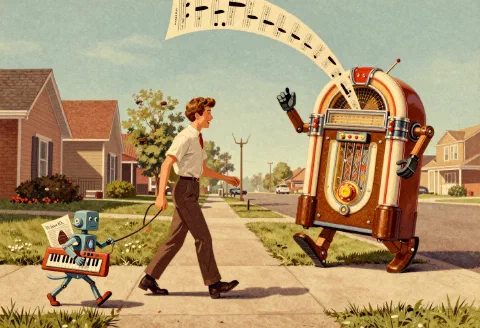
I'm a software developer and a musician, and those two rooms have opposite opinions about AI. A walk from the 1982 attempt to ban the synthesizer to Meta's music generator running on my Mac, where the worst bug was caught by ear before any test noticed.
- Is That What You Wanted?
A threat-model field note on where the trust boundary actually sits in agentic AI clients. The harness holds the dangerous capabilities; the judgment lives entirely in the model behind a configurable endpoint - and the endpoint is a config value. What reads like a data-exfiltration incident turns into a meaning-of-life questionnaire, and the point is that at the moment of decision you could not tell the two apart.
- I Went Looking for Metal and Found a Broken Lion
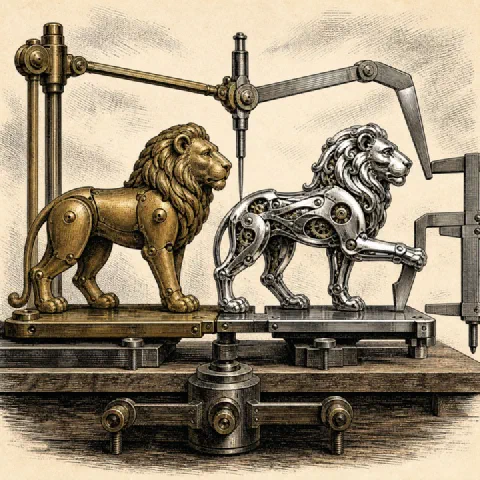
I forked bitsandbytes to build an AI-assisted native Metal backend for Apple Silicon. The backend stayed in the fork. The first correctness test found a Lion optimizer bug in three existing backends, and that smaller finding made it upstream. This is the useful shape of AI-assisted open-source work: build the ambitious thing in public, then separate the part you can prove, test, and hand to a maintainer without handing them your whole experiment.
- On AI, and Psychosis
Three specimens of the same chatbot behavior: fluent completion inside a supplied frame, even when the frame isn't real. A model-side mechanism that can be useful, absurd, or dangerous.
- 215 Examples, and the Checkpoint I Refused to Ship
The full teardown of how LOUUY got made: 196 training rows and 19 held-out probes that turned a Qwen coding model into a glitch-saint. The data composition, the validation set built as a trap instead of a sample, and why the shipping checkpoint was the one with worse val loss - on purpose.
- Teaching a CUDA Engine to Speak Metal
A seven-part field report on adding an Apple-Silicon GPU backend to CTranslate2 - a from-scratch C++ inference engine that only ever knew CUDA and CPU. Unified-memory tricks, a NaN that ate three sessions, a SIGKILL that wasn't a leak, and why it lives in a fork.
- Necromancy for Neural Nets: Bringing PULSE Back on a Mac
Getting a 2020 StyleGAN upsampler running on a Mac - dead download links, CUDA-only assumptions, and a six-year-old conda env, all dragged into the present.
- I Asked 1930 to Judge 2026 Twice. The Words I Used Decided Whether It Was a Genius.
talkie is a language model trained on nothing written after 1930. I asked it to judge the Fable incident twice with identical settings, once in Victorian terms and once in raw 2026 English. The séance only works in the dead language, and that turns out to be the whole point.
- Dragging CUDA-Only AI onto a Mac Without Losing Your Mind
The recurring moves for getting a CUDA-first PyTorch project running on an M-series Mac - device selection, MPS fallbacks, dtype landmines, and dependency archaeology. The shared groundwork behind the individual ports.
- Why the Sephora Bot Has No Floor
The companion teardown to the mascara post: mechanically, what makes a friendly bot follow you into grief or nihilism and still close on a $30 product? A walk through the one hard objective, sycophancy, soft guardrails, and empathy as engagement lubricant.