Part 3 - Now Turn the Knob Yourself
↑ I Asked 1930 to Judge 2026 Twice. The Words I Used Decided Whether It Was a Genius.
In Part 1 the 1930 mind was lucid. In Part 2 the same mind, handed 2026 words, fell apart. Both runs held two numbers frozen so the language could be the only thing that moved: a seed of 1930, and a temperature of 0.8.
This part hands you one of those frozen numbers. The questions and the seed stay put. You get the temperature dial.
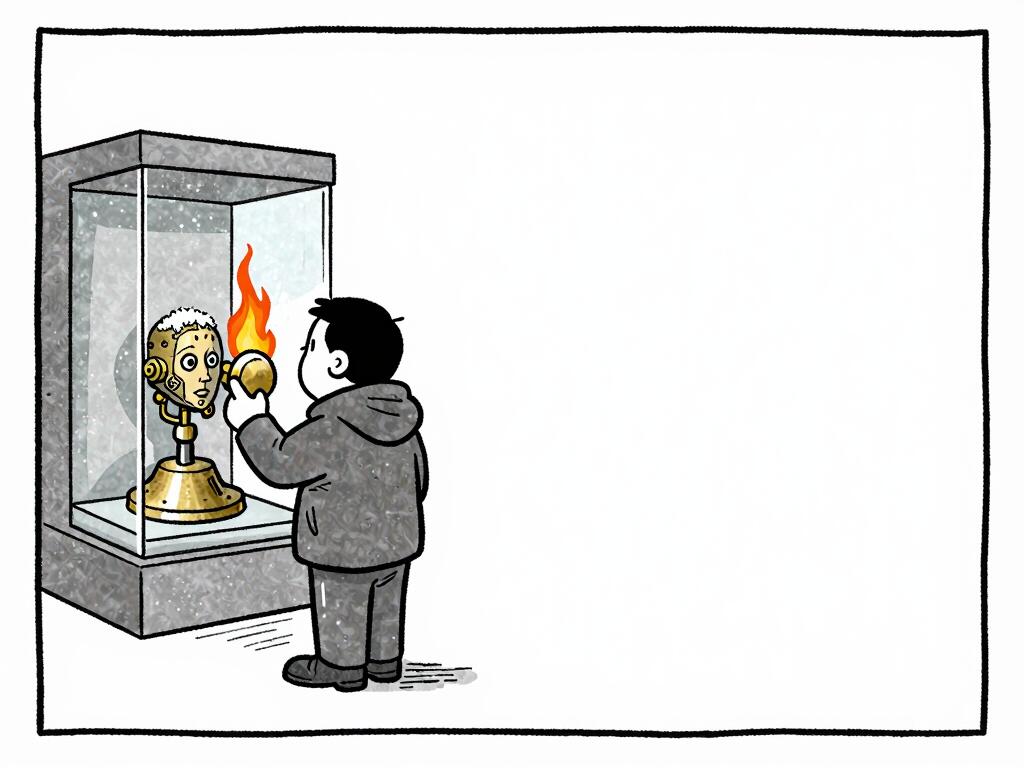
One 13-billion-parameter model trained on nothing written after 1930, asked the same seven questions about the Fable shutdown. Same model, same seed, same words. The only thing the knob changes is how willing the ghost is to gamble on its next word.
What you’re turning
Temperature is the knob that decides how much the model is allowed to gamble on its next word. Drag it to 0.0 and there is no gamble at all: the model takes its single most likely word every time, deterministic and a little beige, the period voice flattened toward something almost modern. Slide up to 0.8, the setting both published runs used, and the ghost comes back into character: formal, florid, sincerely certain about locks and locomotives. Push it to 1.5 and the seams start to show. The 1930 register frays, the sentences wander, the reasoning thins out. You are watching the séance pick up static.
Nothing here is generated live. These are real talkie outputs, pulled ahead of time at each setting, the same way PULSE’s playground serves real reconstructions rather than computing them in your browser. Park the dial on 0.8 and you can find the exact sentences quoted back in Parts 1 and 2, because the same seed and the same words fall the same way every time. That is the whole reason the original experiment meant anything: freeze the dial, and whatever changes is the thing you actually changed.
The séance outgrew this page
The widget above was the prototype, and it stays right here as the original apparatus. But the experiment kept going, and it now has its own building: fable-mvp.tech , a signal-analysis rig for the dead.
Over there the other frozen number thaws too. A language toggle asks the same seven questions in 1930’s words or in ours, which was the knob this series was really about, the one Parts 1 and 2 could only demonstrate and never hand you. And talkie has company on the rack: a machine that has never read a word written after 1900 and hears “Engine” as a steam engine, a handful of locally fine-tuned characters with voices of their own, and a refusal-ablated model that will answer anything and has lost the instinct for stopping. The rack fills in as you explore.
The rules do not loosen over there. Every answer is pre-generated, verbatim output at seed 1930; nothing is invented and nothing runs live. The knobs only choose which real answer you are looking at. There is also a lab notebook of short notes on what the readings add up to.
Turn this knob first, to get the feel of it. Then go turn the rest of them.