Necromancy for Neural Nets: Bringing PULSE Back on a Mac
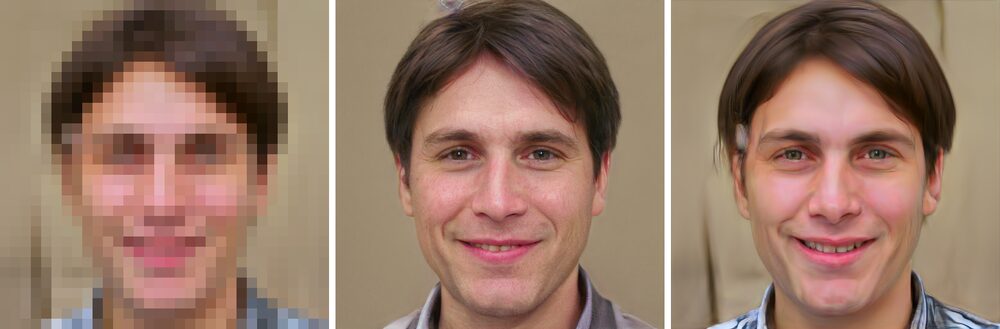
PULSE (CVPR'20) turns a blurry 16×16 face into a sharp 1024×1024 one. It doesn’t paint the detail back in pixel by pixel. Instead it searches a GAN ’s latent space for a realistic face that, shrunk back down, matches the blurry input. The catch: the original code only runs on an NVIDIA GPU, and the model weights it needs are long gone from the internet. This is the story of getting it running on an M-series Mac in 2026.
What PULSE actually does
Most super-resolution works the obvious way: train a network on millions of (blurry, sharp) pairs until it learns to map one to the other. PULSE doesn’t do that, and the sleight of hand is the whole reason it’s worth reviving.
It never trains anything. It takes a StyleGAN generator that is already trained - a frozen machine that turns about 512 numbers into a photorealistic face - and then adjusts those input numbers by gradient descent , leaving the machine itself untouched. Normal training does the reverse: it tweaks the machine and leaves the inputs alone. PULSE flips that. It hunts the latent space for a set of numbers whose 1024×1024 face, shrunk back down, lands on your blurry input. PULSE solves restoration as a search against the frozen model, starting with only your blurry input.
This has a consequence people find unsettling, and it matters enough to say plainly: PULSE does not recover the original face. Instead it invents a new one. The detail the blur threw away is gone for good. What comes back is a believable face that happens to match the blur. Run it twice and you get two different people who both shrink down to the same photo. The original authors were blunt about what this means. PULSE cannot be used to un-blur and identify a real person. And the search has a known bias: it leans toward the kinds of faces that were common in StyleGAN’s training data. Any resemblance to a real person is a coincidence, and also, mathematically, the entire point.
So reviving PULSE isn’t reviving a face-recovery tool. It’s reviving a beautifully weird piece of math: a search that walks across a whole landscape of imaginary people.
See it for yourself
You don’t have to take my word that it invents people. Here is the revived machine with the dials in your hands: one blurred portrait, two hundred and forty real PULSE reconstructions, and four sliders to walk between them. The input, for the record, is a blurred picture of me, which felt like the fair choice. PULSE cannot give me back. It hands you strangers who happen to shrink down to my face, which is about the most de-evolved thing you can do to a person.
Watch the right-hand pair while you turn the knobs. The bottom thumbnail is the input blur; it only moves when you touch Thinness, because thinness is the blur. The top one is whatever face you just summoned, shrunk straight back down. PULSE’s promise is that those two are the same blur, and at high Steps they are. Crank Steps down to 25 and watch the top blur drift off the bottom one: that gap is the search running out of road before it landed.
PULSE's whole claim: shrink the big face down and it lands on the input. When the search converges, these two blurs match. Short searches (low Steps) don't get all the way there, and you can see the top blur drift from the bottom one.
240 real PULSE runs from one blurred portrait. Same input every time; the knobs only change which believable person the search lands on.
That is the payoff. If you came for the faces, this is a fine place to stop. The rest is how I dragged a six-year-old, CUDA-only research script onto a Mac to make those runs, for the kind of person who finds that part fun. I am that kind of person.
The 2026 problem
The code is from 2020, and 2020 is a foreign country. The original environment.yml pinned
Python 3.8 and PyTorch 1.5 to exact 2020 builds, plus a pile of packages the code never
imports (matplotlib, pandas - the usual research-repo barnacles). None of those old versions
install cleanly on a modern machine, and half of them never mattered.
And the weights, the actual trained “brain”, were hosted on Google Drive links that died
years ago. PULSE needs three files to run: synthesis.pt and mapping.pt (its repackaged
StyleGAN CelebA-HQ weights) and dlib’s shape_predictor_68_face_landmarks.dat for finding and
straightening the face. The Drive links are dead. A later mirror is dead. The download path
is a tombstone; a fresh clone just errors out reaching for files that no longer exist
anywhere the code knows to look.

The three fixes that got it breathing again: device, weights, and a modern env
Three moves, and they map onto the generic playbook monsters - they just showed up here in PULSE costumes. (The moves themselves show up in every one of these ports; I wrote the generic versions up once in Dragging CUDA-Only AI onto a Mac .)
Device auto-select (device.py). The original says device="cuda" like it’s reading a
law of physics. The fix is one tiny module that picks the best backend in the building:
CUDA → MPS
→ CPU - and an environment-variable escape hatch for when an
MPS op isn’t implemented yet:
def get_device():
    forced = os.environ.get("PULSE_DEVICE")
    if forced:
        return torch.device(forced)
    if torch.cuda.is_available():
        return torch.device("cuda")
    if hasattr(torch.backends, "mps") and torch.backends.mps.is_available():
        return torch.device("mps")
    return torch.device("cpu")
Every module imports that one shared device. The real labor was hunting down the hardcoded
'cuda' strings scattered three files deep - the 1-million-sample tensor PULSE draws to
estimate the latent distribution, the (batch, 18, 512) latent itself, every noise tensor,
the loss builder. All of them said device='cuda'; all of them now say device=device.
PULSE_DEVICE=cpu python run.py forces the slow-but-reliable path when you need to know whether
a bug is yours or Metal
’s.
Local weights, download as fallback. Instead of fetching from dead links, PULSE.py and
align_face.py now load the three files straight from the repo root if they’re present,
and only attempt a download if they’re missing. The dead URLs are kept as commented context,
which is the decent thing to do - a reader deserves to see where the bodies are buried. One
nice accident of the original design: gaussian_fit.pt (the cached mean/std of the mapping
network over a million samples) is committed to the repo, which means mapping.pt is only
needed to regenerate that file. In practice you can run the whole thing with just
synthesis.pt.
Modernized pulse.yml. Rebuilt on Python 3.13 / PyTorch 2.10 / torchvision 0.25, plus
only the libraries the code actually imports (numpy, scipy, pillow, requests, dlib)
and cmake, which you need before creating the env because dlib compiles against it.
Crucially, all three backends now run an identical torch - the CUDA box and the Mac aren’t
on different stacks, so a result that reproduces is a real result, not a version artifact.
Two bugs that were pure PULSE, including one that silently wrote nothing
Generic monsters aside, two problems were specific enough to this code that they’re the actual reason this post exists.
The dtype hack that only spoke CUDA. The differentiable downscaler in bicubic.py built
its filter tensors by string-formatting the device name into a type:
filters1 = self.k1.type('torch{}.FloatTensor'.format(self.cuda))
On CUDA that interpolates to torch.cuda.FloatTensor. There is no
torch.mps.FloatTensor - the whole torch.<device>.FloatTensor naming scheme is a CUDA-era
fossil. The fix is the modern idiom: register the kernels as module buffers (so they follow the
module across .to(device)) and type_as the input tensor so dtype and device stay aligned
automatically. A classic dtype landmine, wearing a 2020 string-formatting trick as a disguise.
The epsilon gate
that silently produced nothing. This is the good one. PULSE’s loop yielded
its result only if the downscaling loss got within eps (default 2e-3); otherwise it printed
“Could not find a face that downscales correctly within epsilon” and yielded nothing at
all. That threshold was tuned on CUDA. Run the same optimization on MPS or CPU - where the
arithmetic differs in the last bits and convergence lands a hair short - and a perfectly good
run would finish having written zero output files. The run exits successfully into an empty
runs/ directory and a confused afternoon. The fix is to always yield the best
image the search found and treat eps as a stopping hint, not a publication gate. A
convergence threshold someone hardcoded for their GPU is exactly the kind of assumption that
turns into a silent failure on yours.
(There’s a smaller one too: run.py wraps the model in DataParallel, which only makes sense
for multi-GPU CUDA and isn’t supported on MPS - so the fork only wraps when it actually sees
multiple CUDA GPUs, and otherwise moves the input onto the device itself.)
Results, and where the search wanders off
Once it ran, the fun part was confirming the math survived the move - that I’d ported the machine, not just gotten it to stop crashing. The cleanest way to prove that is a parameter sweep: same input, same seed, change exactly one knob, watch the result move the way the paper says it should.
Here’s the headline case - a face shrunk to 16×16 and upscaled 64× (the paper’s marquee demo), with one parameter changed per row:
| Run | What changed | Final L2 | Final GEOCROSS | Converged |
|---|---|---|---|---|
| baseline | defaults (100*L2+0.05*GEOCROSS, W+) | 0.0020 | 0.608 | step 100 |
-tile_latent | one shared latent (W) not 18 (W+) | 0.0020 | 0.000 | step 28 |
-loss_str "100*L2+1.0*GEOCROSS" | 20× stronger realism penalty | 0.0020 | 0.027 | step 100 |
-loss_str "100*L2" | realism penalty removed | 0.0020 | - | step 20 |
-noise_type fixed | noise frozen, not optimized | 0.0020 | 0.574 | step 100 |
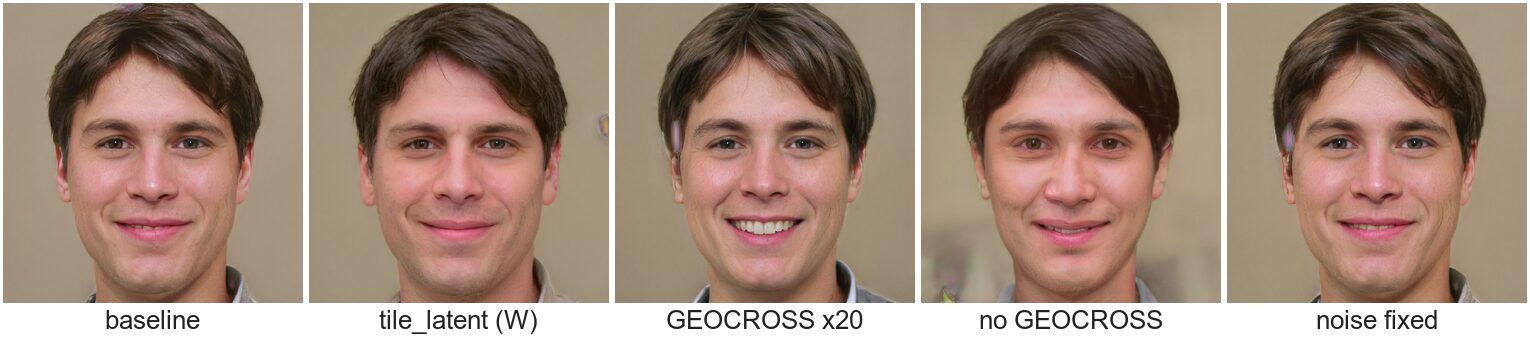
The tell is the first column: every variant reaches the same L2 (0.0020). Each one
shrinks back down onto the input equally well. They are all valid answers. What the knobs change
isn’t whether it matches, it’s which believable person you land on while matching. Drop the
GEOCROSS realism term and the search finishes fastest (step 20), because now it only has to
match the pixels. It is also the most free to wander away from real-looking faces and hand you
something subtly off. That gap between “matches the pixels” and “is a face you’d believe” is the
whole point of PULSE, and a hard 64× input pulls it wide open. Look back at the strip: “no
GEOCROSS” is the one that wandered off to a different person. (The
repo’s README
runs the same sweep on an easier 32x32 input,
where every knob lands on near-enough the same face. The freedom only opens up when the input
gets this thin.)
The reanimation worked. A six-year-old research script that assumed a Linux box with an NVIDIA card under the desk now searches a landscape of imaginary faces on a laptop with no fan noise, and lands on the same numbers it did in 2020. The body’s different. The ghost is intact.