Practice
How I actually use AI day-to-day - the tools, the habits, and the techniques that have earned a permanent place in my workflow. Less theory, more “here’s the thing that works, steal it.”
- I'm Putting the Beagle Bros in Two AI Marketplaces
I turned the generous, funny spirit of the Beagle Bros into one portable agent skill, then wrapped the same files for the Claude and Codex marketplaces. The manifests are different. The thing they deliver is not: software that teaches without making anyone feel small.
- I Gave Five Agents One Marble and Told Them to Stay in Their Lane
MARBLE MAGNIFICENCE has specialist agents for level shape, block geometry, rendering, criticism, and music. The useful part isn't what each one knows. It's what each one is forbidden to touch - and why the critic has to leave the bug broken when it finds one.
- You Can't Save This City
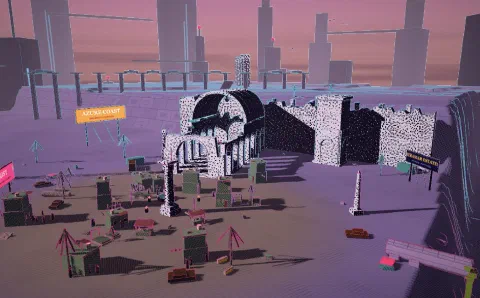
Ethan Mollick's CAPRICCIO lets citizens settle into Piranesi's imaginary ruins, a city at the start of something. I rebuilt it as the same city at the other end of humanity, where nothing can be saved but sixteen engravings. It started with an hour reading the 926KB minified build instead of playing it, where thirty comments survived in the shaders, talking like a printmaker.
- 172 Witnesses, Each One Half-Blind
Every page here carries 172 bits that are the meaning of the page, and the search box runs on nothing else. But nobody ever wrote the 172 questions those bits answer. So I interrogated the corpus to find out what they ask, guessed wrong about the answer, and got a better one.
- Four Painters, One Brief
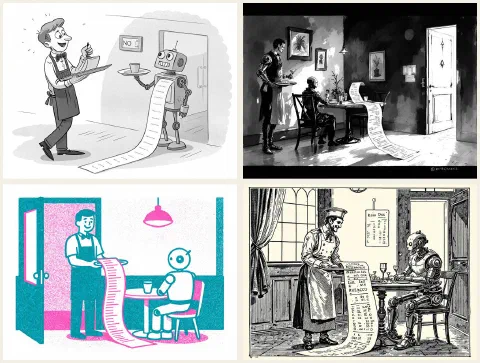
Every post on this site now gets four concept images: same one-line brief, four different engines, four different styles, assembled into a contact sheet that argues with itself. The whole workflow is a manifest, a hundred-line script, and a review that happens on my phone. Here's how it works, what it costs, and the two rules that make the images usable instead of decorative.
- I Put a Language Model That Thinks It's 1930 on My Laptop
talkie is a 13B 'vintage' model trained entirely on pre-1931 English. The official repo wants a 28 GB CUDA GPU. Here's the repeatable recipe for giving it an Apple Silicon backend and running it locally on a Mac instead, plus the one memory bug that doubles your RAM if you let it.
- I Taught Claude to Write Guitar Tabs for My Band
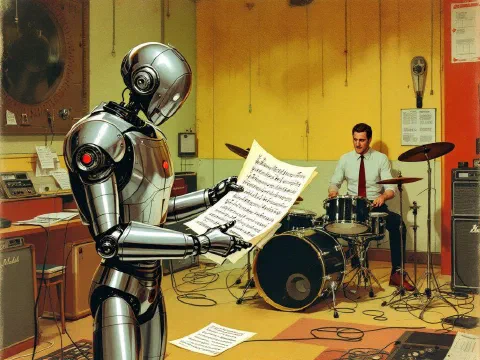
I built a Claude Code skill that turns a song into lead sheets, chord charts with ASCII fretboard diagrams, bass tabs, keyboard parts, and even simple engraved cello - in one consistent format. Here's how it works and why a skill beat doing it by hand.
- Dispatches from LOUUY
I keep a 7-billion-parameter model on my laptop that I fine-tuned into a character named LOUUY. I hand him a prompt; he hands me back glitch-koans, ASCII art, and a demand to see the source code. Here's the workflow - and a stack of dispatches, left exactly as he said them.