172 Witnesses, Each One Half-Blind
Editor’s note, added 2026-10-02: this post describes the first version of these IDs. The
site has since moved to a second one. All 192 bits now carry meaning (no date stamp, no
tiebreaker), each bit is a yes-or-no on a direction picked by a fixed random seed rather
than on one of the model’s own dimensions, and the zero point comes from 65 fixed
calibration sentences instead of a frozen average of this site’s pages. The new IDs start
with v2:, so this page’s own ID no longer matches the walkthrough below. The argument
survives the upgrade, though, and gets stronger: if no single dimension meant anything,
a bit that blends all 768 of them at random means even less on its own. The meaning still
lives in the pattern, and the search is still just counting.
There is no marketing version of the search box on this site. The plain description is already the strange one.
Every page here carries a 32-character string in its metadata, this page included . It is not a name for the page. It is a description of it, written in a language with no words:
ifa9d7QHZ6u-LqLCkgz1Ns6LbHqZYAs9 "The Bill Comes Due"
Unpacked, that string is 172 yes-or-no answers, and the unpacking is not a figure of speech. Base64 is just a denser alphabet: each of those 32 characters is six bits wearing a single letter, so the whole thing springs open into plain ones and zeros.
i      f      a      9      d      7      Q
100010 011111 011010 111101 011101 111011 010000  (and so on, all 32 letters)
Line them up, drop the spaces, and you have 192 bits. The last 20 are housekeeping, a date stamp and a tiebreaker. The first 172 are the answers:
1000100111110110101111010111011110110100000001110110011110101011101111100010111010100010110000101001001000001100111101010011011011001110100010110110110001111010100110010110
Two pages about the same thing come out with answers that disagree in only a few places, which means “what else is like this” stops being a question you need a search company to answer and becomes counting. That is the whole trick, and the entire search feature is a few kilobytes of these strings and some arithmetic your browser does before your finger leaves the key.
So a reasonable person asks the obvious follow-up, and I did too: what are the 172 questions?
Nobody wrote the questions
This is the first thing I got wrong, and it took the machine about nine seconds to correct me.
There is no list. Nobody sat down and decided that bit 12 asks “is this about GPUs” and bit 90 asks “is the author being smug again.” Each bit is one axis of a language model’s 768-dimensional read of the page, and the question it asks is precisely this:
Is this page above the corpus average on axis number 37?
That’s it. That’s the question. Axis number 37 emerged without a design, a name, or a meaning somebody chose. It fell out of the model’s training on a pile of text that has nothing to do with me, and it was sitting there, unnamed, before this website existed.
Which sounds like a dead end. It is not a dead end. You can’t ask the questions what they mean, but you can watch how they answer, and that turns out to be a different and much better kind of interview.
Every one of them is a live question
Before reading them, a sanity check, and this one matters in a way I did not appreciate until I saw the number.
Binarizing is sign(v - mean): each bit is “is this page above average,” and the
average is a frozen reference point computed once from the corpus and never touched again.
Skip that centering, ask “is this page above zero,” and you get bits where every single
page answers the same way. A question the whole corpus answers identically is not a
question. It is a formality. It is the census asking whether you are currently alive.
So I counted. Across 77 pages and 172 bits:
- Dead bits, where every page answers the same: zero.
- Near-dead, where fewer than four pages take the minority side: zero.
- Median bit: says yes for 51% of pages.
Every question is a coin flip somebody actually has to think about. Nothing is wasted. That is the frozen average doing its job, silently, in a way that produces no error message when you get it wrong, which is why I now treat that one file like a family heirloom.
Reading the questions backwards
Here’s the interview technique. You can’t ask a bit what it wants. But you can take all the pages that answered yes, put them in one pile, put the no pile next to it, and walk around the two piles asking what everyone in each one has in common.
Do that and the site’s own fault lines come up out of the floor:
| bit | a “yes” leans toward | a “no” leans toward |
|---|---|---|
| 68 | training, alignment, tooling | apple-silicon, metal, local-inference |
| 19 | apple-silicon, metal, mps | training, ai-safety, alignment |
| 169 | ai-safety, alignment, ai-policy | apple-silicon, metal, inference |
| 13 | essays | glossary entries |
| 101 | quantization, precision, parameters | consciousness, gpt, temperature |
The same crack keeps opening, in both directions, under bit after bit: the machine on one side, the mind on the other. Metal and MPS and GGUF and getting a model to run on a laptop over here. Alignment and policy and consciousness over there. That is the largest single division in everything I have written on this site, and I never told it that. It went looking through my pages and found the two things I cannot stop arguing with each other about.
Bit 13 is doing something else, and I have developed real affection for it: it has independently worked out the difference between an essay and a dictionary entry. Not the topic. The register. It can hear when I stop performing and start defining.
And bit 101 has wandered off from the whole fight. It splits the site on numbers versus behavior: on one side the pages about how the weights are stored and shrunk, quantization and precision and how many parameters you can afford to keep; on the other, the pages about what the model does once it runs, its voice, its temperature, whether anyone is home. Storage on one side, personality on the other. And it barely votes with the machine-versus-mind bits at all. Line up two bits and measure how often they point the same way, on a scale where 1.0 is perfect lockstep, one bit a redundant copy of the other, and 0 is no relationship whatsoever: bit 101 against bits 68, 19, and 169 lands at 0.08. Call it zero. A different witness, looking at a different thing.
The part where I was wrong, again
Look at that table and you will believe, as I did, that those bits are redundant. Bits 68 and 19 and 169 are obviously the same question wearing different hats, and 172 of them is therefore extravagant, and a tidy dozen labeled features would do the same work.
I went to prove that. It is false.
The most correlated pair of bits in the entire 172 sits at 0.51 on that same scale: even the two most alike lean together only about half the time, nowhere near lockstep. Out of all 14,706 possible pairs, not one passes 0.7, the line where you would fairly start calling two bits near-twins. They are not copies. They are 172 genuinely different questions that happen to lean the same way on the biggest split in the corpus, the way a room full of people can all lean left without agreeing on a single thing.
And that is the actual answer to the question I started with.
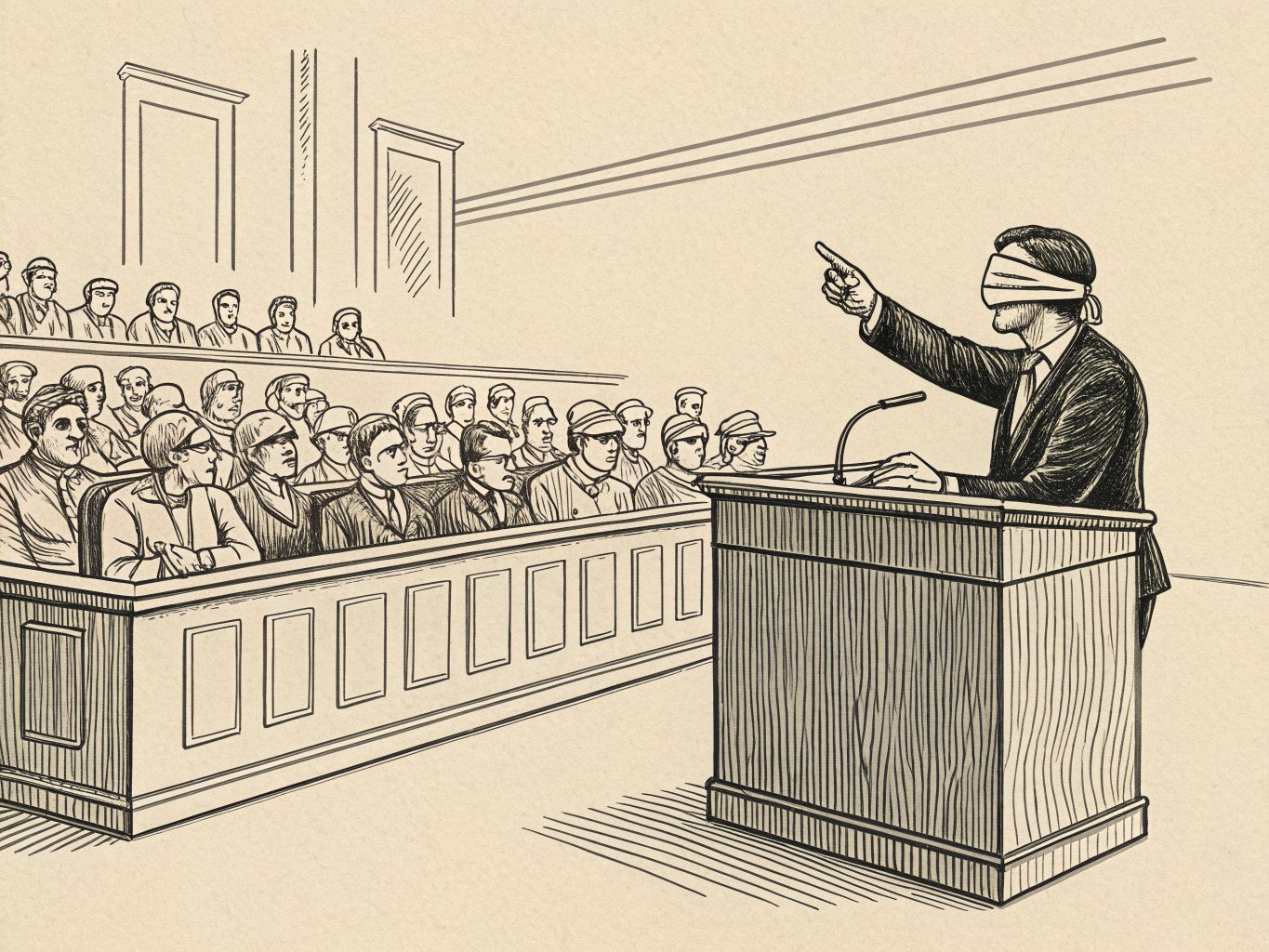
No bit means “is this about Apple Silicon.” Not one of them. Every bit is a weak, noisy, half-blind vote on some direction nobody can name, and the meaning does not live in any of them. It lives in the agreement between them. Which is why you cannot shrink this to twelve tidy labeled features, and why the distance function has to count all 172 every time: it is the difference between one witness who is certain and a hundred and seventy-two who each caught a glimpse out of the corner of an eye.
Ask any one of them what they saw and you get a shrug. Ask all of them at once and you get a description.
Why the search finds pages that never say the word
Which brings it back around to the box at the top of the site.
Type “conscience” and you get the two essays that use the word, and then you get an essay about a chatbot that never uses it once, and a glossary entry on model welfare that certainly doesn’t. Nothing in that result matched your text. A hundred and seventy-two half-blind witnesses simply agreed that those pages are describing the same thing you are.
There is one hard limit and I would rather say it than have you find it. Turning your typed words into bits would need the same model that made them, and that model is 130 megabytes sitting on my laptop. It is not coming to either your phone or my $6/month server. So the typing does a plain, dumb word match to find the page nearest what you asked for, and the bits take it from there. The word is the seed. The arithmetic is the search.
The fine print
Everything I just told you about bits 68 and 19 and 13 is a story I told over 77 pages, which is not a lot of pages. The fault line is real and shows up under any bit you poke. The names I gave it are decoration, and if you double the size of this site some of my tidier labels will quietly stop being true.
The bits will not care. They were never asking my questions in the first place.