I’m Putting the Beagle Bros in Two AI Marketplaces
I was born in 1980, so computers arrived in my life before I had enough context to find them strange. My dad was the hardware guy. There were machines in the house, there were disks, and there were manuals. No internet. No tutorial video waiting in another tab. If you wanted the machine to do something new, you read whatever came in the box and tried it.
The Beagle Bros documents were different from everything else in the pile.
They were funny, for one thing. Not funny the way a corporation becomes funny after six people approve a joke about Mondays. They were plainly made by people who were delighted by computers and a little suspicious of anyone trying to make them sound solemn. The catalogs looked like Victorian patent-medicine broadsides. Tips came with pointing hands. Product names had better timing than some sitcoms.
But the jokes are not why I kept going back to them.
I was seven or eight years old. I wanted to make silly games, and a fair amount of what I typed was still magic-incantation territory. Those documents never made me feel stupid for being at the beginning. They assumed I was curious, capable, and on my way. You could laugh at a line one year, understand the trick underneath it the next, and discover something else on the third pass.
That is the part I wanted to keep.
So I made it an agent skill. Now I am packaging the same skill for the Claude and Codex marketplaces, which has turned into a tidy little lesson about what should be portable and what should stay platform-specific.

A sensibility, not a costume
The obvious bad version of this project would be a nostalgia filter. Sprinkle in some old-timey language, add a manicule, call every error a confounded contraption, and congratulate yourself on having invented 1983.
That is not what made Beagle Bros useful.
The skill is built around a few practical rules. Technical substance comes first. The joke has to survive beside the instruction, never in place of it. Irreverence points at the machine, the bureaucracy, or the person writing the software. It never points down at somebody who has not learned the trick yet. Good documentation volunteers the extra tip. Product copy can have a pulse without hiding a warning or sanding off an important detail.
In short: be funny when funny helps, be plain when plain matters, and treat the person reading like a smart friend.
That gives the agent something more useful than an impression to perform. It can rewrite a README, sharpen release notes, warm up a CLI, improve an error message, name a feature, sketch a Peeks & Pokes-style tip card, or look at a design and ask whether it teaches anything besides how proud the designer is.
The invocation is deliberately boring:
Use $beaglebros to rewrite this README introduction without losing any technical detail.
The last six words are doing real work. A funny manual that lies is still a bad manual. It just has a hat now.
One skill, two front doors
Claude and Codex can both use the same basic skill directory. At its center is a SKILL.md
file with a name, a description, and the operating instructions. Detailed material lives in
separate references for history, voice, visual language, and product ethos. That keeps the
entry point small and lets the agent pull in the part that matters for the current job.
The marketplace packaging around that directory is where the platforms differ.
The public repository now has this shape:
.
├── skills/beaglebros/
│   ├── SKILL.md
│   ├── agents/openai.yaml
│   └── references/
├── .claude-plugin/plugin.json
└── .codex-plugin/plugin.json
Both plugin manifests point at the same skills/ tree. Claude gets the plugin description it
expects. Codex gets its own plugin manifest plus the agents/openai.yaml presentation layer
for the skill list, default prompt, and automatic invocation policy. The wrappers know how to
introduce the package to their respective hosts. Neither wrapper owns the actual skill.
That distinction is small enough to miss and important enough to save future me from a mess.
I could have made a Claude version and a Codex version. They would be identical on day one, nearly identical on day thirty, and quietly disagreeing by day ninety. A new writing rule would land in one copy. A better historical reference would land in the other. One marketplace would be teaching generosity while the other was still wearing last month’s fake mustache.
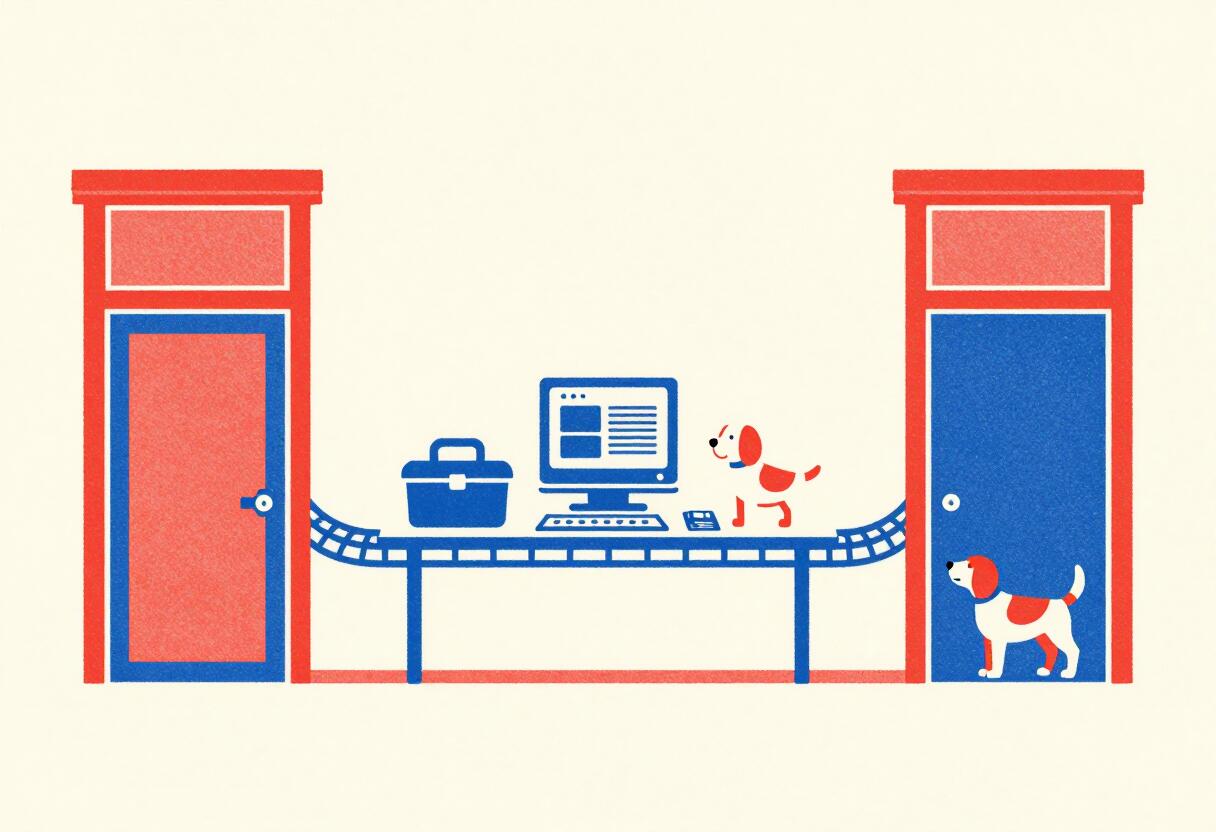
Instead, the shared skill stays boringly canonical. Platform-specific metadata sits at the edges. Adding another host should mean writing another thin front door, not raising another copy of the house.
The description is the switchboard
A skill has to be discoverable before it can be useful. Both agents see the name and description first, then decide whether the rest of the package belongs in the current conversation.
That makes the description less like marketing copy and more like routing code written in English. It has to say what the skill changes and when that change is welcome. Too vague, and the agent never reaches for it. Too broad, and suddenly a database migration is wearing a straw boater and shouting “Behold!” at the transaction log.
The current description routes writing, documentation, product copy, error messages, naming, retro visual direction, and design gut-checks into the skill. It does not claim the Beagle Bros should supervise everything. Nobody needs a Victorian woodcut in a TLS certificate failure.
This is one of the things I like about skills as a form. A system prompt is atmosphere. A skill is a tool with a handle. It has a boundary, supporting material, a reason to be selected, and a moment when it should stay on the pegboard.
What the marketplaces are actually distributing
The package is MIT-licensed and unofficial. It is inspired by the historical Beagle Bros software house, not affiliated with it, endorsed by it, or pretending to resurrect the company. The marketplace listings are not live yet. The shared package and both platform wrappers are in place; submission is the next bit of paperwork.
The code is the least interesting part. There are no heroic dependencies, no service to keep alive, and no elaborate installer waiting to ruin a Sunday. It is Markdown, a pair of small manifests, and enough structure for two different agents to find the same set of ideas.
What gets distributed is a decision about how software should behave around people.
It should explain the trick. It should assume curiosity instead of incompetence. It should be willing to have a personality without making that personality somebody else’s problem. It should remember that delight is not the enemy of rigor. Sometimes delight is what gets a kid to read the same manual for the twentieth time, long enough for the strange incantation to become something he understands.
I am packaging the skill for two modern AI marketplaces because distribution is how a tool gets used. I am keeping one shared copy because the principle underneath it should not change with the storefront.
The manifests open two doors. The same little pointing hand is waiting behind both of them.